The business grew — and control slipped away
While a company is small, everything stays in plain view: the owner remembers every client, every task and every payment. But as you grow, the number of clients, people and parallel activities exceeds what anyone can hold in their head and in chat threads. You start to feel the business "blurring": everyone seems busy, but who is responsible for what — and where the money is — is unclear. This page is about regaining control without turning into a manual dispatcher.
The problem it solves
What breaks with growth isn't motivation — it's visibility. Tasks live in chats and verbal agreements, clients live in someone's phone, and the status of a deal is known only to the manager running it. The owner learns about a problem after the fact: a missed deadline, a lost client, an invoice no one sent. Trying to regain control through endless "how's it going?" check-ins and manual reports only eats up time and irritates the team.
This scenario closes the gap like this: all the work — tasks, clients, deals, documents — is run in one place, every unit of work has an owner and a next step, and the manager sees a consolidated picture on a dashboard in real time instead of assembling it by hand.
How it works in LadVen OS
Control comes back because work becomes visible and structured:
- Tasks — all of the team's work with an assignee, a deadline and a result, not lost in chats and verbal agreements.
- CRM — clients and deals with stages, owners and a next step.
- Dashboards — a summary by department and process: what's in progress, where the overdue items are, where the money is.
- Control by exception — the manager reviews what's overdue and stuck, rather than every step of everyone.
- Automation — the system takes over routine task creation and reminders.
- Access rights — everyone sees their own area, while the manager sees the whole picture.
Where control used to slip away
Growth exposes the usual points of loss: verbal instructions that leave no trace, a client only one manager knows about, a deal with no next step, an invoice nobody issued. In LadVen OS each of these points gets an owner, a deadline and a place where the status is visible — so work stops "falling through" between people and days.
How it looks in practice
A year ago the company had three managers and fifty-odd clients — the owner kept it all in their head. Now there are fifteen managers and hundreds of clients, and the old way has stopped working: who promised what to whom, which deals are on fire, who is overloaded — none of it is clear.
After the switch, the picture assembles itself. Every deal lives in a pipeline with an owner and a next step, every task with an assignee and a deadline. The manager opens the dashboard and in a minute sees the value of deals in progress, the conversion rate, what's overdue and where the bottleneck is. There's no need to call managers around and stitch spreadsheets together — the data updates in real time. Where a problem used to surface after the fact, it's now visible in advance: a deal with no movement for three days is highlighted, an overdue task is in plain sight.
Control is back, but it's a different kind: not total surveillance, but a view by exception. The manager spends minutes a day on "what's happening" instead of hours.
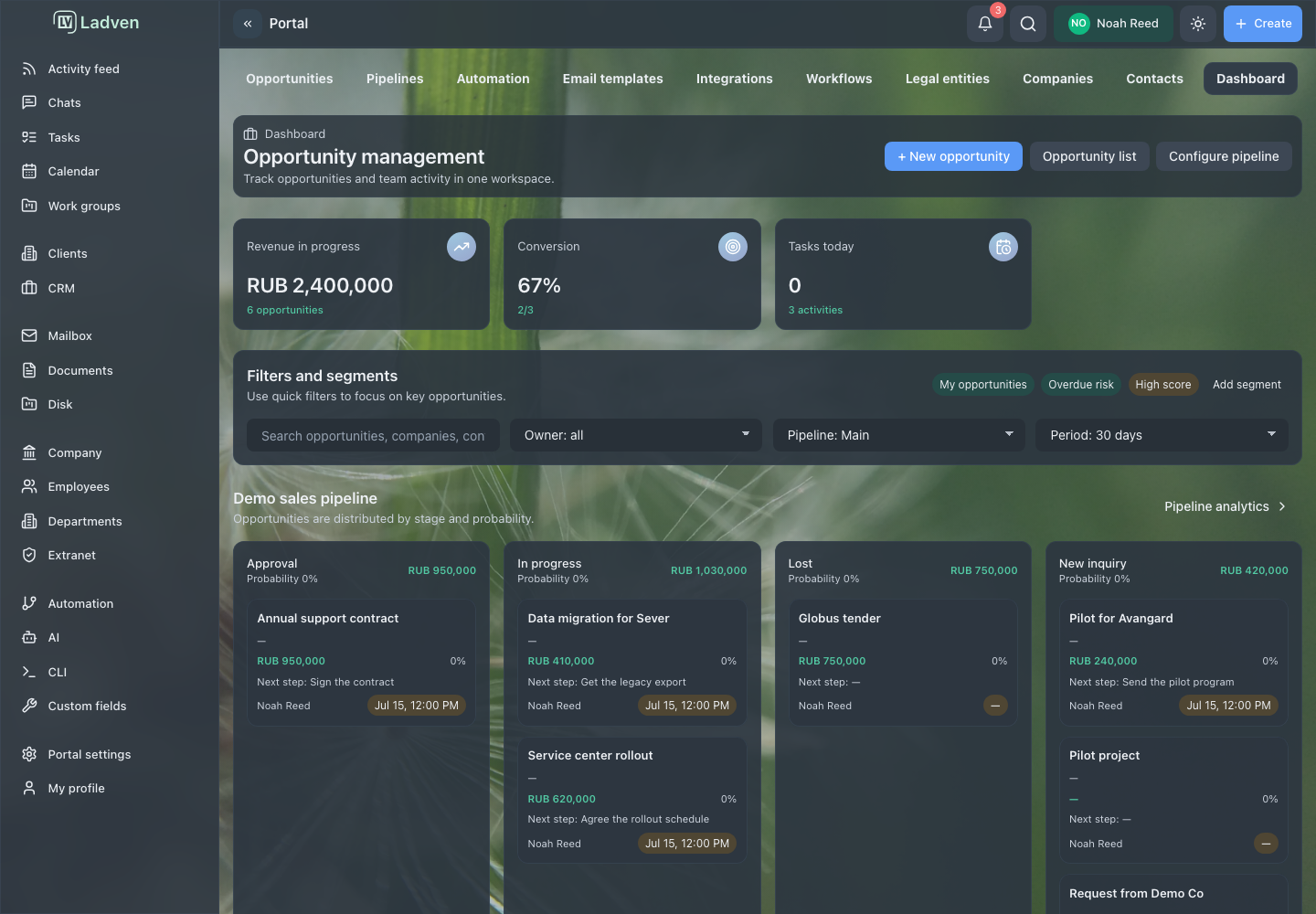
A single glance shows where the money is and what needs attention — no manual reports.
What the business gains
- the manager sees the real picture instead of piecing it together;
- nothing gets lost: every task and deal has an owner and a next step;
- problems become visible in advance — through overdue items and lack of movement, not after the fact;
- the team works by clear rules, not by the memory of individual people;
- the owner stops being a "manual dispatcher".
Implementation checklist
- Move the team's tasks into a single list with assignees and deadlines.
- Add clients and deals to the CRM with stages and owners.
- Introduce the rule: every task and deal has an owner and a next step.
- Set up the manager's dashboard: overdue items, deals with no movement, workload.
- Hand the routine over to automation: creation of standard tasks and reminders.
- Agree on control by exception instead of daily "how's it going?" check-ins.
What to avoid
- Don't try to keep a growing business in your head and in chat threads — that is the very source of lost control.
- Don't regain control through manual reports and surveys — it eats time and doesn't scale.
- Don't control every step of everyone — run control by exception.
- Don't leave tasks and deals without an owner and a next step.
How to measure the result
- the share of tasks and deals that have an owner and a next step;
- the time the manager spends assembling the picture — it should trend toward zero;
- the share of overdue items and deals with no movement;
- the number of "lost" clients and forgotten matters — it should go down.
Where to start
- Tasks — gather the team's work in one place.
- CRM — clients and deals with owners and stages.
- Manager control and dashboard — a consolidated picture without manual reports.
- AI and automation — take routine and reminders off the manager's plate.
Request a demo
Want to see what control over a grown-up business looks like on a ready-made environment? Request a demo — we'll show you dashboards, tasks and CRM on a configured demo portal and help you move your process onto it.